← Home · Slopes & Walls

Active and Passive Anchor Design in Lethbridge

Together, we solve the challenges of tomorrow.

LEARN MORE →

The Oldman River valley cuts through Lethbridge exposing layers of silty clay till over soft shale and sandstone. Anchor capacity here depends almost entirely on which layer you bond into. We run pull-out tests on every project. No exceptions. The till can hold decently in compression but its shear strength drops fast if the bond zone gets wet. For deeper cuts near the coulees we often combine anchors with a cpt test to confirm the bedrock profile before drilling. In West Lethbridge the till is thinner. You hit bedrock faster. South Lethbridge near the river gives us layered deposits that complicate free length estimation. Our lab verifies grout strength at 7 and 28 days as part of every anchor installation program. The seismic classification under NBCC 2020 puts Lethbridge in a moderate hazard zone, which influences the lock-off load for permanent anchors.

Anchor bond stress in Lethbridge shale can be triple what you get in the overlying till—but only if the grout cures without shrinkage.

Process and scope

North Lethbridge sits on thicker glacial till deposits. Anchor capacities tend to be lower there unless you reach the bedrock. South Lethbridge near the coulees gives us weathered shale at shallower depths. That changes the bond stress values entirely. We see bond stress in the range of 150 to 400 kPa in stiff till, jumping to 600-900 kPa in competent shale. The design must account for creep in the till layers. We specify performance tests on at least 5% of production anchors. Suitability tests go higher. Proof tests on the rest. A plate load test at the wall base helps confirm the bearing stratum before anchor inclination is finalized. For temporary excavation support in sandier pockets we sometimes recommend a footings inspection too if the wall carries vertical load. Our pull-out rig logs load versus displacement continuously. We watch for the creep rate exceeding 2 mm per log cycle, which tells us the ground is yielding.
Active and Passive Anchor Design in Lethbridge
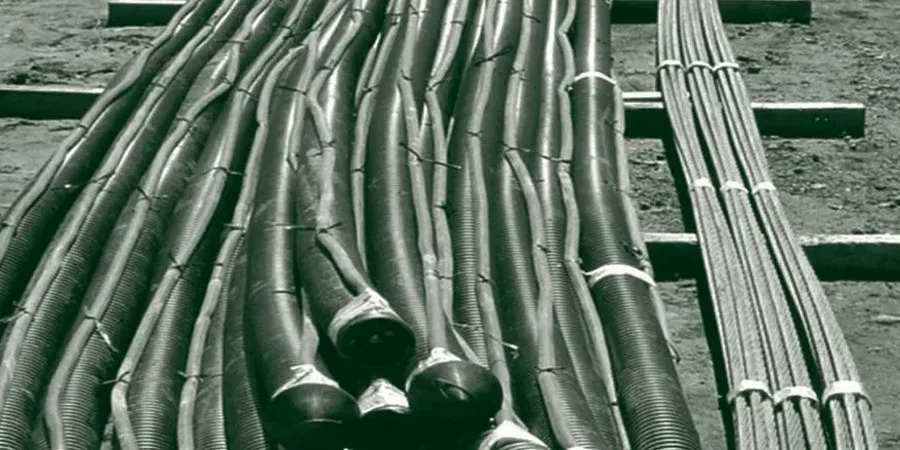
Technical reference image — Lethbridge

Local ground factors

A commercial excavation near Scenic Drive hit a pocket of saturated silt at 6 meters. The anchors kept creeping under proof load. We pulled 2 mm in the first log cycle. The contractor stopped work immediately. We ran additional grain size analysis on the cuttings. The fines content was above 60%. That explained the poor bond. The solution involved deepening the bond zone into the shale below, re-drilling the anchors, and using a slower grout injection rate to avoid hydrofracture. If the anchors had been locked off without catching that creep, the wall would have moved. In Lethbridge the transition from till to bedrock is rarely flat. It undulates. You cannot assume uniform bond length across a site.

Need a geotechnical assessment?

Reply within 24h.

Email: info@geotechnicalengineering.xyz

Typical values

ParameterTypical value
Anchor TypeActive (prestressed) and passive (reaction)
Typical Bond Stress in Till150-400 kPa
Typical Bond Stress in Shale600-900 kPa
Performance Test Frequency5% of production anchors
Maximum Creep Rate2 mm per log cycle at proof load
Grout Strength Verification7-day and 28-day cube tests

Complementary services

01

Pull-Out and Suitability Testing

We mobilize a test rig to apply incremental loads up to 133% of the design load, recording displacement at each step. Suitability tests run on sacrificial anchors before production starts.

02

Bonded Length Design

Calculation of the bonded length based on site-specific bond stress values from testing, not just from textbook tables. We adjust for grout type and installation method.

03

Lock-Off and Lift-Off Verification

On-site verification of the lock-off load using a calibrated jack. We check residual load after seating losses to confirm the anchor is performing as designed.

Relevant standards

CSA A23.3 Design of Concrete Structures (anchor embedment), NBCC 2020 Seismic Hazard for Lethbridge, PTI DC35.1 Recommendations for Prestressed Rock and Soil Anchors

Quick answers

How much does anchor design and testing cost in Lethbridge?

For a typical project with a few anchors and the required performance tests, the cost ranges from CA$1,430 to CA$4,910. The exact figure depends on the number of anchors, access conditions, and whether suitability tests are needed on top of the standard proof tests.

What is the difference between an active and a passive anchor?

An active anchor is prestressed after installation to apply a compressive force to the ground or structure before any movement occurs. A passive anchor only develops resistance once the ground or structure starts to move. In Lethbridge's till we use active anchors for permanent walls to limit long-term creep deformation.

How deep do anchors need to go in Lethbridge soils?

It varies by location. In West Lethbridge the bedrock is shallower so bonded lengths of 4 to 7 meters into shale are common. Near the river valley the till can be 15 meters thick. Anchors there may need a total length of 20 meters or more to reach competent ground.

What tests are required for permanent anchors?

Permanent anchors require suitability tests on sacrificial anchors before production, then performance tests on at least 5% of the production anchors, and proof tests on the remainder. Each test has a specific loading sequence and hold period defined by the PTI recommendations.

Can anchor capacity decrease over time?

Yes, particularly in the glacial till layers common in Lethbridge. Creep can reduce the lock-off load. Corrosion of the steel tendon is another factor if the double-corrosion protection is compromised. We specify lift-off tests on selected anchors at intervals after installation to verify long-term performance.
Location and service area

We serve projects in Lethbridge and surrounding areas.

View larger map