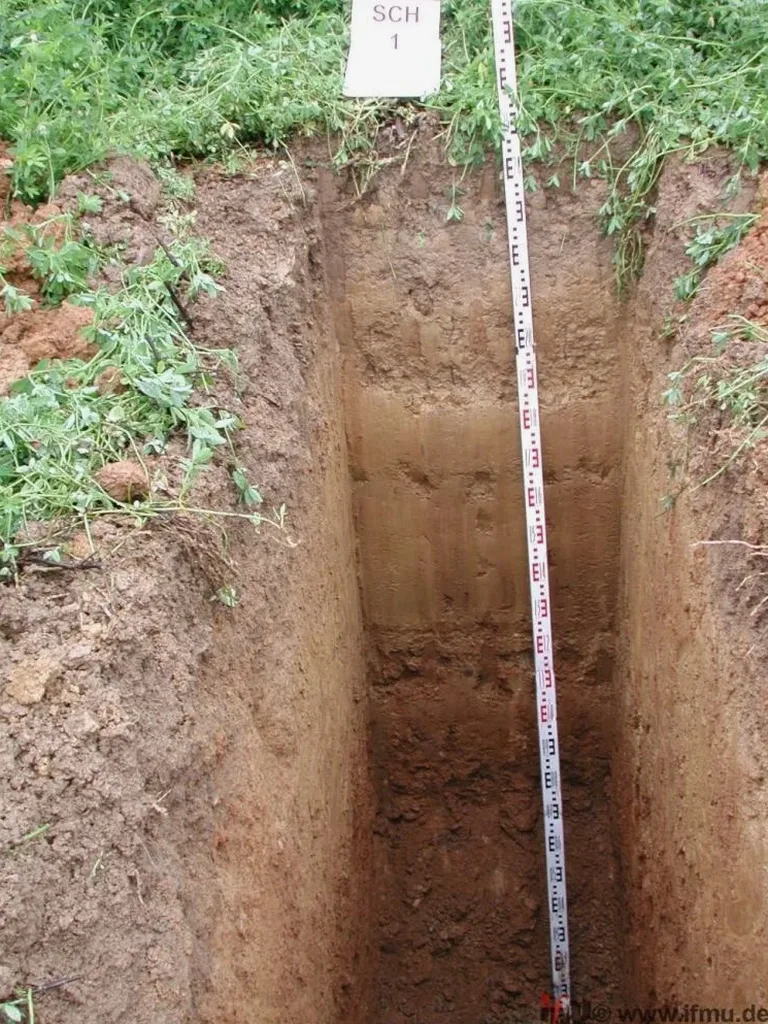
The latest edition of the Alberta Building Code references CSA A23.3 for concrete structures, and any foundation design in Lethbridge starts with knowing what lies beneath the surface. The Oldman River has carved a deep valley through the city, leaving behind a complex mix of glacial till, lacustrine clays, and alluvial terrace deposits that can shift dramatically within a single property. An exploratory test pit remains the most direct and cost-effective method for observing these soil transitions firsthand. Our team logs the stratigraphy, collects undisturbed samples, and documents groundwater seepage at depths where the city's semi-arid climate, with annual precipitation averaging just 380 mm, creates seasonal moisture fluctuations in the upper clay layers.
For projects near the coulees—where slope stability is a natural concern—a physical inspection of the overburden through a test pit reveals fissures, sand lenses, and weak zones that boreholes might miss. We complement this visual assessment with targeted sampling for grain size analysis to quantify the silty clay matrices common across Lethbridge's residential subdivisions.
You cannot design a foundation in the Oldman River valley based on a drill log alone—sometimes you need to climb into the trench and see the soil structure with your own eyes.
Process and scope
With a population approaching 105,000, Lethbridge continues to expand southward and westward into terrain where the Bearpaw Formation shale is close to the surface. This weathered bedrock can look competent in an auger sample but often crumbles upon exposure to air and moisture cycles. An exploratory test pit lets us examine the actual fabric of the shale, measure joint spacing, and decide whether it qualifies as engineered fill or requires over-excavation. We also use the pit to verify the thickness of the preload or gravel pad before placing footings—something that matters a great deal in the hard clay soils of the city's industrial parks.
Our field crew is experienced with the City of Lethbridge's permitting requirements for excavations, including shoring and safe slope standoff distances when working adjacent to existing structures. The work is coordinated to minimize disruption, with same-day backfill in most cases.
Local ground factors
We see a stark contrast between the west side neighborhoods near the university, where well-drained glacial till provides excellent bearing, and the lower-lying areas near the river valley north of Whoop-Up Drive, where soft, compressible lacustrine clays extend to significant depth. In the latter, skipping a test pit investigation before placing footings invites differential settlement that can crack drywall within the first two freeze-thaw cycles.
A test pit also exposes undocumented fill. Lethbridge has grown in phases, and many older lots contain buried construction debris, ash, or organic silt from former coulee drainage paths—materials that simply cannot support a slab-on-grade without removal and recompaction. The direct observation possible from an open excavation eliminates the ambiguity of interpreting a drill log alone.
Quick answers
How long does a test pit stay open in Lethbridge's climate?
We schedule the excavation, logging, sampling, and backfill within a single working day for typical depths. Lethbridge's dry air helps keep trench walls stable, but if we encounter seepage from perched groundwater in the silty layers, we might need a small pump. We never leave an open excavation unattended; the trench is backfilled and compacted immediately after documentation.
What is the typical cost range for an exploratory test pit in Lethbridge?
For a standard test pit reaching 3 to 4 meters depth, with machine time, operator, geotechnical logging, and a factual report, the range typically falls between CA$690 and CA$1,060. Variables include site access constraints, traffic control requirements if the pit is on a boulevard, and the number of disturbed or block samples sent to the lab.
Can a test pit replace a borehole for a new house foundation?
In many shallow foundation scenarios in Lethbridge—especially single-family homes on gently sloping lots—a test pit provides better information than a borehole because you can see the soil structure, check for desiccation cracks in the clay, and measure the actual depth to the water table. However, if the bearing stratum is deeper than about 4.5 meters, we recommend supplementing the pit with an SPT drilling program.
How do you handle backfill and surface restoration?
We backfill in lifts, compacting each layer with a vibratory plate compactor to meet the project's specified density, typically 98% of Standard Proctor maximum. The surface is graded to match the surrounding grade. If the pit is in asphalt or concrete, we saw-cut a neat perimeter beforehand and the client arranges for surface restoration after our work is complete.