← Home · In-Situ Testing

Field Permeability Testing (Lefranc & Lugeon) in Lethbridge

Together, we solve the challenges of tomorrow.

LEARN MORE →

NBCC Division B and CSA A23.3 require a clear picture of subsurface drainage before you pour a foundation in southern Alberta. In Lethbridge, where the Oldman River has carved deep coulees and left behind a mix of glacial till, alluvial sands, and weathered bedrock, guessing the permeability is a fast track to costly dewatering failures. Our field permeability testing covers Lefranc for soil and Lugeon for rock mass, giving you direct in-situ measurements instead of lab-derived estimates that often miss the mark in this semi-arid region. The city sits on a complex stratigraphy — sand and gravel lenses within the till can transmit water faster than the surrounding matrix, and ignoring them leads to wet excavations or undersized sump pumps. We test at the depth your project actually touches, whether it's a shallow footing near the coulee rim or a deep excavation close to the river valley. When we need a complete geotechnical model, we often pair these tests with SPT drilling to log stratigraphy and grain size analysis to calibrate the hydraulic conductivity values against the actual gradation of the deposit.

A single uncorrected Lugeon test in fractured bedrock can overestimate the rock mass permeability by an order of magnitude — we run five-step pressure sequences to get the real number.

Process and scope

Lethbridge expanded rapidly after the construction of the iconic High Level Bridge in 1909, pushing development from the floodplain up onto the prairie uplands. That expansion left the city with a dual personality: older neighborhoods like London Road sit on river terrace deposits with high gravel content, while newer subdivisions to the west rest on stiff glacial till and thin veneers of loess. A Lefranc test in a borehole through a saturated sand lens under Park Place Mall tells a completely different story than a Lugeon test in the fractured mudstone beneath the university area. We run constant-head and falling-head Lefranc configurations depending on the expected k-value, always following ASTM D6391 or the appropriate CSA procedure. For Lugeon tests, we typically use five pressure stages to capture turbulent flow effects and assess fracture dilation. The data feeds directly into dewatering plans — you don't want to discover a 10⁻⁴ cm/s lens when your wellpoint system was designed for 10⁻⁶ cm/s. Before excavation begins, we also recommend a CPT test to map the continuity of these permeable zones across the site.
Field Permeability Testing (Lefranc & Lugeon) in Lethbridge
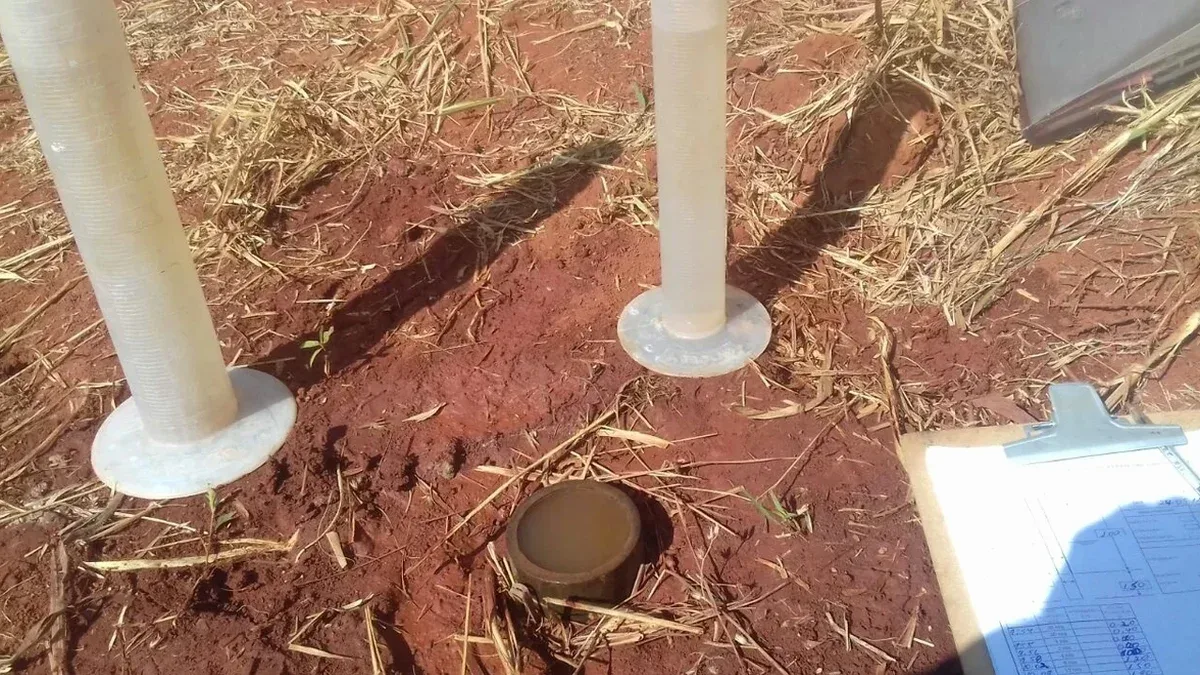
Technical reference image — Lethbridge

Local ground factors

The number one mistake we see in Lethbridge is engineers running a single-stage Lugeon test at maximum pressure and then designing a cutoff wall or grout curtain from that inflated number. The fractured mudstone and sandstone of the Bearpaw Formation react non-linearly to injection pressure — joints open, flow becomes turbulent, and the apparent permeability skyrockets. A proper five-stage test (low-medium-high-medium-low) reveals the actual laminar flow regime and corrects for this dilation. Another classic error is using a lab permeameter on a Shelby tube sample from a gravelly till and assuming that number represents the formation. A Lefranc test in the same borehole often shows k-values 10 to 50 times higher because the test captures the bulk mass permeability, including sand seams and fissures that the tube missed. For projects near the Oldman River, where the water table fluctuates with irrigation season releases from the St. Mary Reservoir system, getting the permeability wrong means your dewatering system fails just when you need it most. We verify field results against site resistivity surveys to map saturated zones before mobilizing the drill rig.

Need a geotechnical assessment?

Reply within 24h.

Email: info@geotechnicalengineering.xyz

Typical values

ParameterTypical value
Test MethodLefranc (variable/constant head), Lugeon (5-stage)
Applicable MaterialSoil and highly weathered rock (Lefranc); Fractured rock (Lugeon)
Measured ParameterHydraulic conductivity k (cm/s) or Lugeon units
Standard ReferenceASTM D6391 (Lefranc), Houlsby method (Lugeon)
Packer ConfigurationSingle or double packer, pneumatic or hydraulic
Depth CapabilityUp to 60 m with standard NQ/HQ tooling
Reporting Outputk-value profile, Lugeon vs. pressure plots, dewatering recommendations

Complementary services

01

Lefranc Borehole Testing

Constant-head and falling-head Lefranc tests in soil and weathered rock. We isolate the test section with a pneumatic packer, measure flow rates at stabilized head, and calculate k-values using the Hvorslev shape factor. Ideal for dewatering design in glacial till and alluvial deposits.

02

Lugeon Rock Mass Testing

Five-pressure-stage Lugeon tests in fractured sandstone, mudstone, and shale of the Bearpaw and Belly River formations. We provide full pressure-versus-flow plots, Lugeon unit calculations, and recommendations for grout takes or cutoff wall design.

03

Dewatering Feasibility Assessment

Combining field permeability data with pumping test analysis and local groundwater monitoring well records. We deliver inflow estimates, wellpoint spacing, and drawdown predictions that account for seasonal Oldman River stage variations.

Relevant standards

NBCC Division B (Part 4, Section 4.2), CSA A23.3 and CSA Z662 for soil-structure interaction, ASTM D6391-11 (Standard Test Method for Field Measurement of Hydraulic Conductivity Using Borehole Infiltration), Houlsby (1976) — Routine interpretation of the Lugeon water-test, Alberta Transportation Technical Standards (ATTS)

Quick answers

What's the difference between a Lefranc test and a Lugeon test?

A Lefranc test measures permeability in soil or highly weathered rock using a borehole cavity, typically with a constant or falling head. It's suited for unconsolidated materials like the glacial till and alluvial sands common around Lethbridge. A Lugeon test applies to fractured rock — we inject water under pressure into an isolated section of the borehole sealed with a packer, measuring the flow rate at different pressure stages. This tells us how the fracture network behaves under hydraulic load.

Do I really need a field test, or can I just use a lab permeameter on a sample?

Lab tests on small samples miss the big picture. A 75 mm Shelby tube doesn't capture sand seams, gravel pockets, or fractures that control the bulk permeability of the formation. In Lethbridge's glacial till, we routinely see field Lefranc values 10 to 50 times higher than lab permeameter results from the same borehole. For any project involving dewatering, slope drainage, or dam seepage, the NBCC expects in-situ data.

What does a field permeability test cost in Lethbridge?

For a Lefranc or Lugeon test program in the Lethbridge area, budget between CA$900 and CA$1,350 per test location, depending on depth, number of stages, and whether we're already on site with a drill rig. A full dewatering assessment incorporating multiple test intervals and a pumping test typically falls in the CA$3,500 to CA$5,500 range.
Location and service area

We serve projects in Lethbridge and surrounding areas.

View larger map