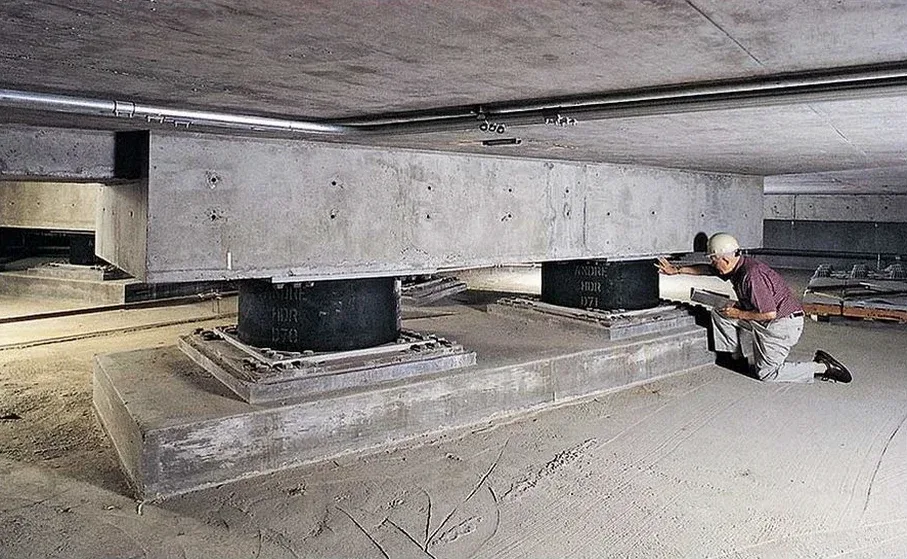
Lethbridge sits atop a complex sedimentary sequence—layered sandstone, siltstone, and coal seams of the Belly River Formation—capped by glacial till and lacustrine clays up to 30 meters thick in the Oldman River valley. The 2020 NBCC places the city in a moderate seismic hazard zone, but the deep soft soils amplify ground motion in ways that uniform hazard spectra alone don't capture. A site-specific seismic microzonation study often reveals spectral accelerations at 1.0–2.0 second periods that exceed code-default values by 15–25%. That's where base isolation changes the design equation. Decoupling the superstructure from ground motion cuts spectral demand at the isolation plane. Our technical team runs nonlinear time-history analyses using scaled accelerograms matched to the uniform hazard spectrum for Lethbridge's coordinates, then sizes lead-rubber or friction pendulum isolators to stay within CSA A23.3 ductility limits for the reinforced concrete frame above.
Base isolation in Lethbridge's soft-soil zones can reduce base shear demand by 40–60% compared to fixed-base design, keeping essential facilities operational after a seismic event.
Local ground factors
Two sites three kilometers apart in Lethbridge can produce isolation designs that differ by a factor of 1.4 in displacement demand. A structure founded on dense till near the University of Lethbridge—Site Class C, Vs30 around 400 m/s—needs a compact isolator with moderate damping. The same floor plan on the glaciolacustrine clays of the river bottom, where Vs30 drops below 180 m/s, requires larger isolators with higher damping and possibly a moat wall extension to accommodate the extra displacement. Skipping a site-specific hazard assessment and defaulting to NBCC Table 4.1.8.4.B values in those soft-soil pockets is the fastest way to undersize the isolation system. The consequence: pounding against the moat, shear key failure, and a superstructure that sees forces it was never designed to handle. We run the numbers for both MCE and SLE levels so the isolator displacement and base shear stay within the manufacturer's tested envelope, verified against EN 15129 or AASHTO guide specifications depending on the isolator type.
Quick answers
Does NBCC 2020 require base isolation for essential buildings in Lethbridge?
NBCC 2020 does not mandate base isolation. It permits isolation as an alternative to conventional force-based design if the isolation system meets the requirements of Clause 4.1.8.19 for response modification and test verification. For post-disaster buildings, isolation is often selected because it achieves the immediate occupancy performance objective more reliably than fixed-base ductile design.
What isolator types work best in Lethbridge's soil conditions?
Lead-rubber bearings (LRB) perform well in the moderate-period range typical of Lethbridge's soft-soil sites, providing both energy dissipation and recentering. Friction pendulum systems (FPS) are a strong choice when uplift is a concern or when the superstructure has variable column loads across the footprint. The selection depends on the spectral shape from the site-specific hazard study.
How much does a base isolation design package cost for a Lethbridge project?
For a building in Lethbridge, a complete isolation design package—including ground motion selection, NTHA, isolator specification, and peer review coordination—ranges from CA$6,530 to CA$12,980 depending on structural complexity, number of isolators, and soil profile variability across the footprint.
What site investigation data do you need before starting the isolation design?
We need a geotechnical report with Vs30 from MASW or downhole testing, borehole logs to at least 30 meters depth, Atterberg limits on the clay layers, and groundwater monitoring data. If the site is on the river valley clays, a CPT profile is strongly recommended to evaluate cyclic resistance and confirm Site Class E boundaries per NBCC.