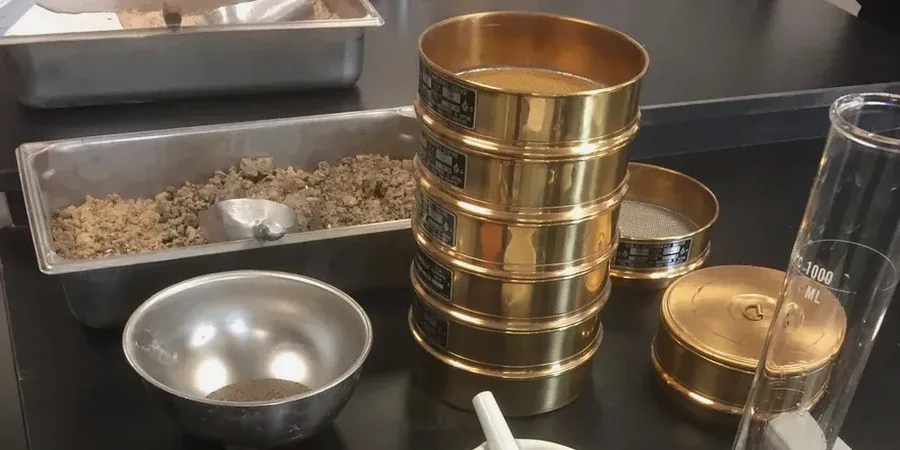
Lethbridge sits perched above the Oldman River valley, a landscape carved by glacial meltwater that left behind a complex patchwork of till, lacustrine clays, and alluvial sands. When the high-level bridge went up in 1909, engineers understood something we still contend with today: the ground beneath this city changes fast over short distances. A trench on the west side can hit stiff till within a meter, while a site three blocks east on the floodplain uncovers silts that a shovel slices through like butter. That variability makes grain size analysis essential for any project here—whether you are designing a stormwater infiltration basin on the north side or verifying subgrade for a commercial slab near Scenic Drive. Getting the gradation curve right means understanding drainage potential, frost susceptibility, and compaction behavior before the first bucket hits the dirt. In our experience, skipping this step in southern Alberta’s glacial terrain leads to surprises that cost far more than the testing itself. We run the full suite—sieve stack plus hydrometer—so the fine fraction does not get ignored, and we cross-reference results with the regional drift stratigraphy mapped by the Geological Survey of Canada.
A sieve-only gradation in Lethbridge’s lacustrine clays can miss 40% of the soil’s mass—that hidden fraction dictates frost design and drainage performance.
Quick answers
How much does a grain size analysis cost in Lethbridge?
A combined sieve and hydrometer analysis typically runs between CA$120 and CA$250 per sample, depending on whether you need a rush turnaround and how much gravel fraction requires extra sieving. Samples with high organic content or unusual dispersant requirements may fall at the upper end of that range.
How long does the hydrometer test take compared to the sieve analysis?
The sieve portion can be completed in one day, but the hydrometer analysis requires a minimum of 24 hours of sedimentation readings and often extends to 48 hours for the full curve. We usually report combined results within three to four business days from sample receipt.
Do I need the hydrometer if my soil looks sandy?
In the Lethbridge area, visual classification is unreliable. Many sands here carry a significant silt fraction from glacial grinding. If the material coats your fingers dusty when dry or feels smooth when wet, the hydrometer will quantify the fines that control drainage and frost behavior—skipping it is a gamble.
What sample mass do you need for a full analysis?
We request at least 500 grams of air-dried material for a combined test. For gravelly soils with particles larger than 19 mm, we prefer a larger bag—around 2 kg—so the coarse fraction is representative. Samples should be sealed in a plastic bag immediately after extraction to preserve natural moisture.