← Home · Investigation

CPT (Cone Penetration Test) in Lethbridge — Continuous Soil Profiling

Together, we solve the challenges of tomorrow.

LEARN MORE →

A recent warehouse expansion near the Sherring Industrial Park hit refusal on a dense till lens at just 4 meters, something the sparse borehole log had completely missed. The contractor lost two days re-mobilizing a larger rig. In Lethbridge, where the surficial geology flips from stiff glacial till to soft alluvial silts within a single block, relying on discontinuous sampling creates exactly this kind of risk. We run the CPT test with a 20-tonne truck-mounted rig that pushes a 15 cm² cone at a steady 2 cm/s, capturing tip resistance, sleeve friction, and pore pressure every 10 mm. The result is a continuous vertical profile that picks up thin sand stringers and clay seams that SPT intervals miss. For sites along the Oldman River terraces or in the new subdivisions pushing west toward Coalhurst, a single day of CPT soundings often replaces three days of conventional drilling while delivering far better resolution on stratigraphic boundaries.

A 20 mm interval in CPT data can reveal a drainage path that a split-spoon sample misses entirely. In Lethbridge's interbedded tills, that interval often controls settlement behaviour.

Process and scope

Lethbridge sits at roughly 910 metres elevation on a high prairie bench carved by the Oldman River, and the city's population has pushed past 100,000 with steady residential growth on both the west and south sides. That growth means more foundations being placed on complex glacial drift, where interbedded clays and tills make bearing layer identification tricky. A standard SPT can misjudge a thin silt seam as a competent stratum; CPT pore pressure dissipation tests reveal whether that layer will drain or trap water under load. We pair our CPT campaigns with grain size analysis when the soil behavior type chart flags transitional materials that need lab confirmation, and we routinely cross-check CPT-derived undrained shear strength against triaxial testing on thin-walled tube samples from the same depth. The cone's continuous record becomes especially valuable in Lethbridge's coulee-edge developments, where a 2-metre vertical shift in bearing stratum can mean the difference between a spread footing and a deep pile solution.
CPT (Cone Penetration Test) in Lethbridge — Continuous Soil Profiling
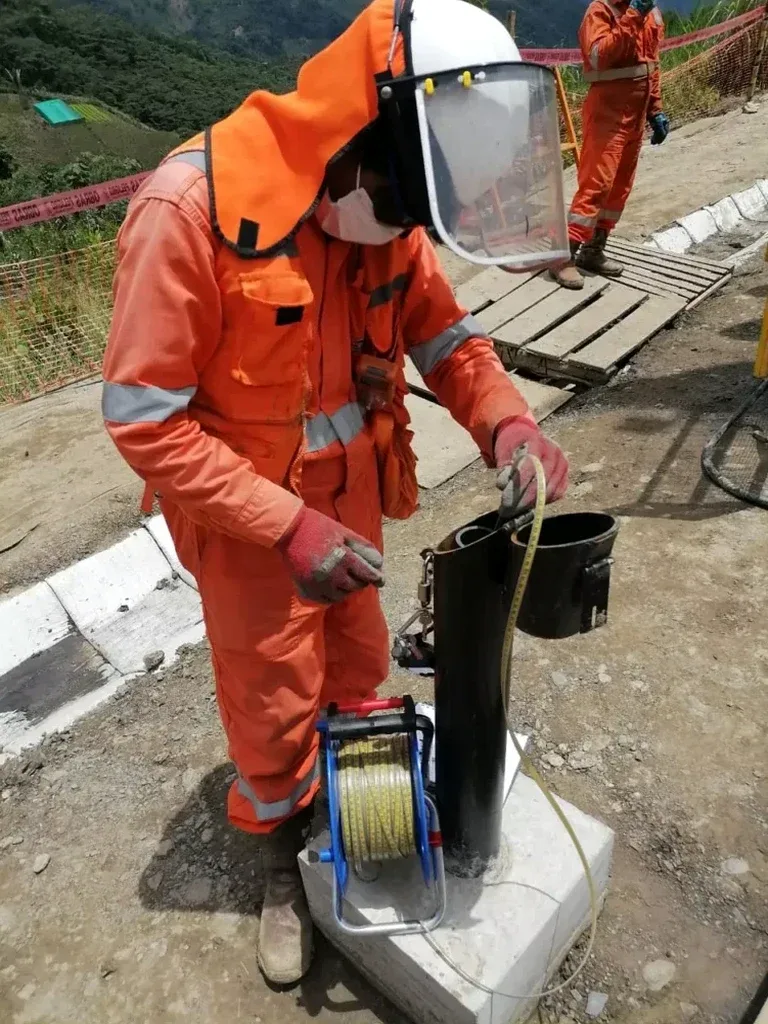
Technical reference image — Lethbridge

Local ground factors

The most common error we see on Lethbridge sites is treating a high tip resistance spike in glacial till as proof of bottom-of-footing competence, without running a dissipation test to check whether the layer is freely draining. A dense silt at 5 metres can look identical to a dense sand on a raw qc trace, but it will trap pore pressure and creep under sustained dead load. We have been called back to three projects in the past four years where differential settlement appeared within 18 months of occupancy, each time traced to an undrained silt layer that neither the borehole log nor the basic CPT interpretation had flagged. Running a proper CPTu protocol with at least one dissipation stop per bearing stratum turns a simple profiling exercise into a real settlement-risk assessment, something that pays for itself before the first concrete truck arrives.

Need a geotechnical assessment?

Reply within 24h.

Email: info@geotechnicalengineering.xyz

Typical values

ParameterTypical value
Cone capacity100 kN (standard), 200 kN for dense gravel till
Cone apex angle60° conical tip, 15 cm² base area (ASTM D5778)
Penetration rate2 cm/s ± 10%, hydraulic constant-rate system
Parameters recordedqc, fs, u2 (shoulder filter), inclination, temperature
Sampling interval10 mm continuous (CPTU standard profile)
Pore pressure dissipationt50 monitoring at select depths, automatic shutoff logic
Soil behaviour typeSBTn chart (Robertson 1990, updated 2016 normalised)
Maximum typical depth25–30 m in Lethbridge till; deeper in soft alluvium before refusal

Complementary services

01

Standard CPT Sounding

Continuous qc and fs measurement to refusal or target depth. Delivered as log sheets, digital data files, and a summary report with SBTn classification per Robertson (2016). Typical production is 4–6 soundings per day on accessible Lethbridge sites.

02

CPTu with Pore Pressure Dissipation

Piezocone testing with u2 shoulder filter. Includes dissipation stops at bearing strata to estimate coefficient of consolidation. Essential for settlement analysis in the Oldman River alluvium and interbedded silt units.

03

Seismic CPT (SCPT)

Cone equipped with a triaxial geophone for downhole shear wave velocity measurement. Used when NBCC seismic site class determination is needed, particularly for schools, care facilities, and multi-storey structures in Lethbridge's Class C and D soil zones.

Relevant standards

ASTM D5778-20 (Standard Test Method for Electronic Friction Cone and Piezocone Penetration Testing of Soils), NBCC 2020 (National Building Code of Canada — geotechnical site investigation requirements), CSA A23.3:19 (Design of concrete structures — foundation design inputs derived from CPT), ISSMGE International Reference Test Procedure for CPT (IRTP, 1999)

Quick answers

How long does a CPT sounding take on a typical Lethbridge site?

A 20-metre sounding in Lethbridge's glacial till, including one dissipation stop and rod changes, typically takes 45 to 75 minutes. Softer alluvial sites near the river bottom go faster; dense gravel till or cobble hits may slow progress or require pre-drilling. We usually complete 4 to 6 soundings in a standard field day, depending on access and depth requirements.

What depth can CPT reach in Lethbridge soils?

In the soft alluvial silts along the Oldman River valley, we routinely reach 25 to 30 metres before encountering refusal. In the stiff glacial till that covers much of the west side and areas toward Coalhurst, refusal typically occurs between 10 and 20 metres depending on cobble content and overconsolidation. We run a 200 kN rig for the harder sites.

What does CPT testing cost in Lethbridge?

Mobilisation and the first sounding generally run between CA$260 and CA$380 per sounding, with a reduced rate for additional soundings on the same day. The exact figure depends on depth, number of dissipation tests, and whether seismic CPT is added. We provide a fixed quote after reviewing the site location and target depth.

How does CPT compare to SPT for foundation design in Lethbridge?

CPT gives a continuous, repeatable profile with far better resolution on thin layers than SPT. In Lethbridge's interbedded till and alluvium, that resolution matters for identifying drainage paths and weak seams. However, CPT does not recover a physical sample, so on some projects we pair it with test pits or targeted SPT to confirm soil type in transitional zones flagged by the SBTn chart.
Location and service area

We serve projects in Lethbridge and surrounding areas.

View larger map