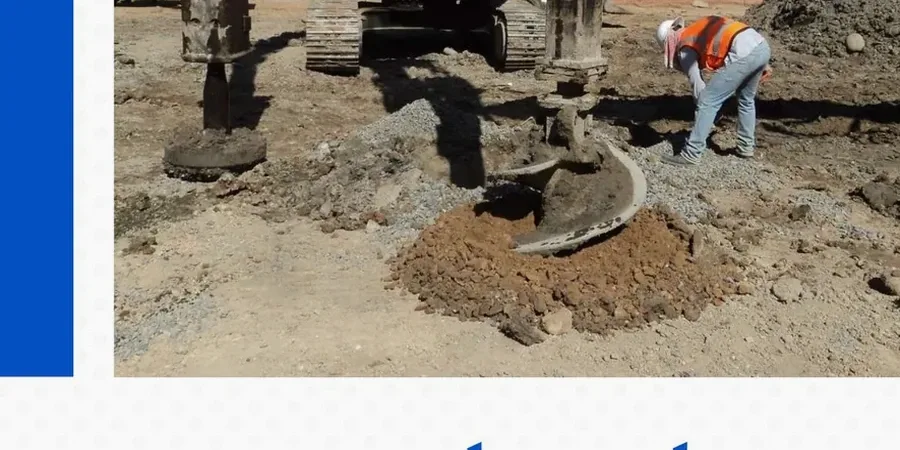
Standing beside a vibroflot rig on a site north of Whoop-Up Drive, you hear the low-frequency hum as the poker penetrates silty clay, backfilled with clean aggregate in controlled lifts. That machine is running a stone column installation sequence, and it is the core of what we specify in Lethbridge. The Oldman River carved deep coulees through the city, leaving behind glaciolacustrine deposits that challenge shallow footings. Our stone column design service turns those weak compressible layers into a stiffened composite mass. We load-test the columns and confirm that the ground can carry your structure without excessive settlement. The approach works for warehouses in Sherring Industrial Park and for residential blocks near Henderson Lake, where soft clay pockets appear without warning.
A well-designed stone column grid can double the bearing capacity of Lethbridge’s glaciolacustrine silts while reducing total settlement by half.
Local ground factors
Lethbridge grew along the Oldman River floodplain and later pushed onto the surrounding prairie uplands, which means today’s construction sites sit on a quilt of alluvial silts, glacial till, and occasional buried coulee fills. The biggest threat comes from soft, normally consolidated clay lenses that were never preloaded by ice, so they compress significantly under load. Skipping a ground improvement assessment in these areas typically leads to excessive differential settlement, cracked slabs, and misaligned structural frames. A stone column design matched to the specific stratigraphy transfers stress to stiffer columns, drains excess pore pressure, and provides a measurable factor of safety. In seismic terms, Lethbridge falls into a moderate hazard zone under the NBCC; liquefaction is less of a driver here than compressibility, but we still check cyclic softening potential when the water table is high.
Relevant standards
NBCC 2020 (National Building Code of Canada), CSA A23.3:19 – Design of Concrete Structures, ASTM D1586 – Standard Test Method for Standard Penetration Test (SPT), ASTM D5778 – Standard Test Method for Electronic Friction Cone and Piezocone Penetration Testing, CFEM – Canadian Foundation Engineering Manual, 4th Edition
Quick answers
How much does a stone column design cost for a Lethbridge project?
For a typical commercial or light industrial site in Lethbridge, stone column design fees range from CA$2,230 to CA$7,280 depending on the treated area, number of columns, and whether CPT testing is already available. Smaller residential lots fall at the lower end, while multi-building developments requiring 3D settlement modeling reach the upper end.
When are stone columns a better choice than deep piles in Lethbridge?
Stone columns work well when the soft zone is less than 12 to 15 metres deep and the structural loads are spread across a raft or strip footing system. They avoid the cost of pile caps and grade beams, and they accelerate drainage in silty soils. If bedrock is extremely deep or point loads are very high, we compare both options side by side.
What information do you need to start the design?
We need a site plan with column loads, a geotechnical report with SPT or CPT logs, and the allowable settlement criteria from your structural engineer. If existing boreholes are shallow, we may recommend additional CPT soundings to reach the full depth of the compressible layer.