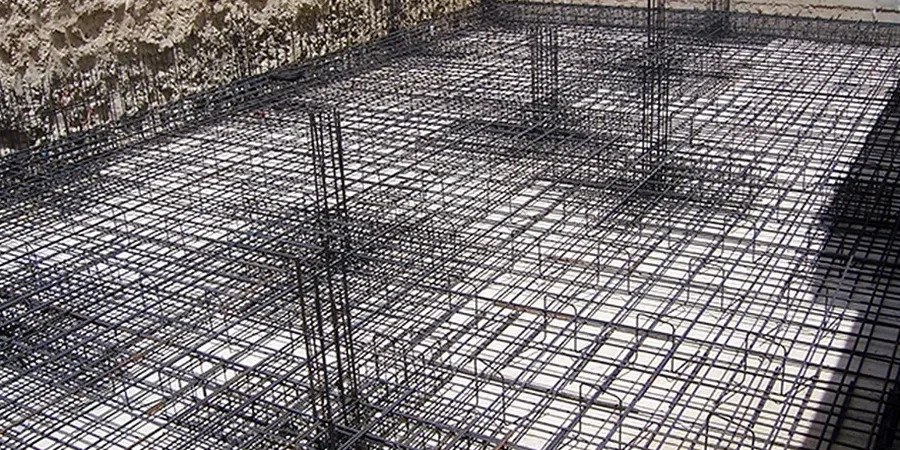
Lethbridge sits at 910 meters above sea level, carved into the Oldman River valley by wind and water. That elevation brings a specific challenge: a deep clay till overlying bedrock. We see it on every site. The clay is stiff, sometimes slickensided, and it expands when wet. A conventional footing might punch through or tilt over time. That is why many commercial and mid-rise projects here turn to a raft or mat foundation. The slab spreads the building load across a broader area. It bridges minor soft spots. In our experience, when the bearing stratum sits deeper than two meters, a properly designed raft prevents differential settlement. For high-plasticity clays near the coulees, we often pair the design with a grain-size analysis to confirm the proportion of fines driving the swell potential. The city’s 2025 building permit stats show a clear trend toward raft solutions in the new industrial parks east of Highway 3.
A rigid raft turns the entire footprint into a single bearing element—critical when Lethbridge’s clay expands and shrinks with the seasons.
Local ground factors
The geological record here tells a story of Glacial Lake Lethbridge. The lake left behind thick sequences of silty clay. When that clay dries out during a Chinook wind event, it shrinks. When the snow melts or irrigation begins, it swells. This shrink-swell cycle is the number one cause of slab distress in the city. A raft foundation mitigates the risk, but it does not eliminate it. The biggest danger we document is edge curl. If the perimeter loses moisture faster than the interior, the slab corners lift. That induces serviceability failures in superstructure cladding. Another risk is frost heave on unheated portions of the slab. We specify non-frost-susceptible granular fill beneath the entire raft footprint. A minimum 300 mm layer of clean, crushed gravel compacted to 98% Standard Proctor density. In flood fringe zones along the Oldman River, buoyancy checks are mandatory for any raft deeper than 1.5 meters. The design must include a factor of safety of 1.2 against uplift under the 1:100-year flood elevation.
Quick answers
What soil conditions in Lethbridge make a raft foundation the best choice?
The glacial lake clay deposits found across much of the city are prone to volume change. When the undrained shear strength drops below 75 kPa or the plasticity index exceeds 25%, isolated footings become uneconomical. A raft foundation bridges these soft zones and provides uniform settlement control.
How does frost depth affect mat foundation design in southern Alberta?
The NBCC specifies a frost penetration depth of at least 1.2 meters for Lethbridge. We design the edge beams to extend below this depth and place a minimum 300 mm of non-frost-susceptible granular fill beneath the entire slab to cut off capillary rise and prevent ice lens formation.
Do you handle the concrete mix design for the raft slab?
We specify the performance criteria—strength class, exposure class, and maximum water-to-cement ratio per CSA A23.1. The ready-mix supplier provides the final mix design, which we review for compliance with the structural drawings and local durability requirements.
What is the typical cost range for a raft foundation design package in Lethbridge?
For a full geotechnical and structural design package, the cost typically ranges from CA$1,280 to CA$6,340. The final figure depends on the building footprint area, the complexity of the soil profile, and the number of column load cases requiring analysis.