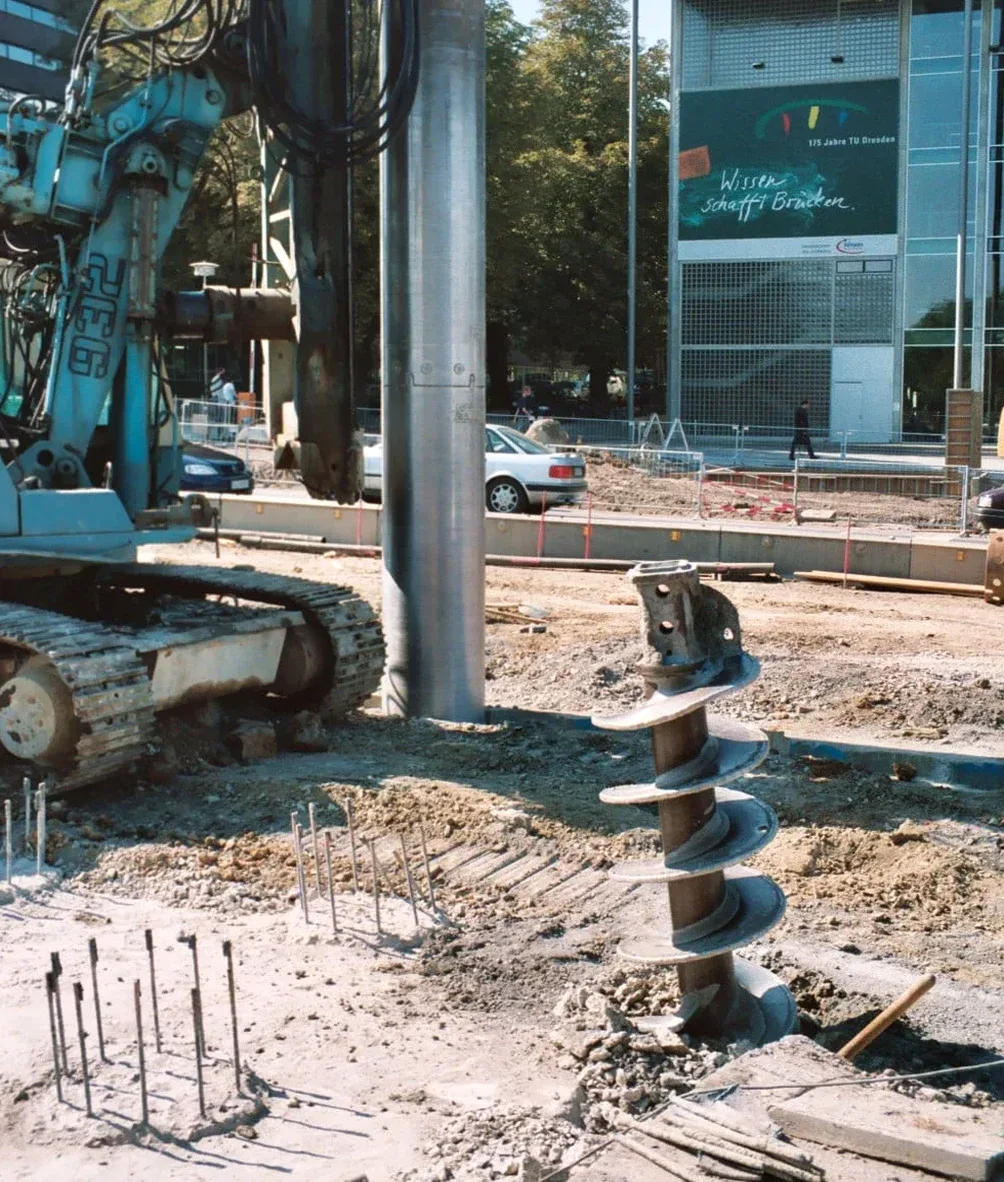
Lethbridge sits on a thick sequence of glacial lacustrine clays and silts overlying Cretaceous bedrock, with groundwater often encountered within 3 meters of the surface. This soil profile demands deep foundations for any structure with moderate to high column loads. The local stratigraphy includes the Lethbridge Till and underlying soft lake deposits that can lose strength when disturbed. Our team runs a full pile foundation design program—from site investigation to axial capacity verification—following NBCC 2020 and CSA A23.3. If boreholes show extensive soft zones, we integrate data from CPT testing to refine the tip resistance and identify thin sand lenses that could serve as a bearing stratum. Every design parameter ties back to measured soil properties, not textbook assumptions.
Designing piles in Lethbridge means understanding the transition from stiff till to soft lake clay—and making sure the toe is deep enough to stay out of trouble.
Local ground factors
The west side of Lethbridge, particularly near the coulees, presents a different risk profile than the flatter east bench areas. Proximity to the Oldman River valley means potential for lateral soil movement and deeper soft clay deposits that can cause negative skin friction if the ground settles around the piles. On the east side, the till is typically shallower and denser, but isolated pockets of saturated silt can liquefy under the 1-in-2475-year earthquake ground motions specified in the NBCC. We evaluate both conditions explicitly. Liquefaction-induced downdrag and lateral spreading loads are not afterthoughts in our design reports. We also check for the presence of shallow bedrock—the Bearpaw Formation can appear at highly variable depths across the city, and piles terminating in weathered shale require careful socket design to prevent creep under sustained load.
Relevant standards
NBCC 2020 – National Building Code of Canada, CSA A23.3:19 – Design of Concrete Structures, CFEM – Canadian Foundation Engineering Manual, 4th Edition, ASTM D1143 – Standard Test Methods for Deep Foundation Elements Under Static Axial Compressive Load, ASTM D4945 – High-Strain Dynamic Testing of Deep Foundations
Quick answers
What soil information is required before starting the pile foundation design in Lethbridge?
We need a geotechnical investigation with at least one borehole per building footprint, extending to a depth of at least three pile diameters below the expected toe elevation. The borehole logs should include SPT N-values, field vane shear strength tests, and laboratory classification of the glacial till and lacustrine clay layers. If groundwater is encountered, standpipe piezometer readings over a few weeks help us confirm the design water level. Cone penetration test data, where available, gives us a continuous strength profile that complements the borehole information.
How much does a pile foundation design package cost for a project in Lethbridge?
The design package, including axial and lateral capacity calculations, settlement analysis, and construction specifications, typically ranges from CA$2,000 to CA$8,270 depending on the number of piles, the complexity of the soil profile, and whether dynamic load testing supervision is included. Small residential projects with a few helical piles sit at the lower end. Commercial buildings with large pile groups and lateral load demands from coulee-edge conditions fall at the upper end.
How do you account for the coulee slopes in pile design?
We run a slope stability analysis using the geometry of the coulee cross-section and the measured shear strength of the soil layers. The factor of safety for the slope determines the setback distance for the piles. If the piles must be placed within the zone of potential movement, we calculate the lateral forces that a slow-moving soil mass would impose on the pile shaft and add that to the structural load case. In some cases we recommend deeper piles socketed into the Bearpaw Formation to isolate the foundation from the shallower sliding surface.
What pile types are most common for Lethbridge soil conditions?
Driven steel H-piles and closed-end pipe piles work well in the dense upper till, but can be difficult to drive through cobble zones. Continuous flight auger (CFA) piles are common for medium-rise buildings because they minimize vibration and can be installed through the soft clay to bear in the till or bedrock. Helical piles are an option for lightly loaded structures, especially on the east side where the till is shallow. We select the pile type based on the soil profile, load requirements, and site access constraints.