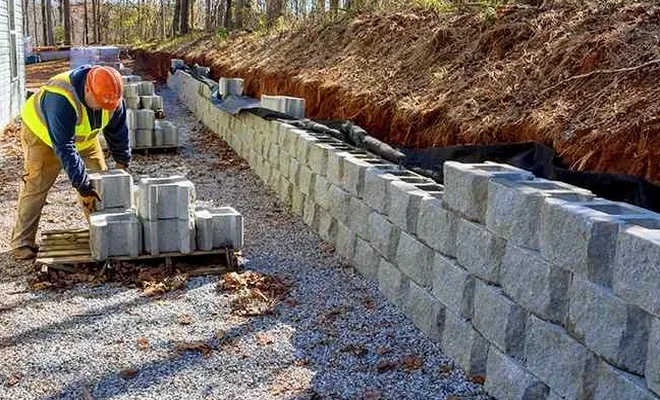
The ground beneath West Lethbridge and the river valley floor tells two completely different stories. Up on the west bench, you hit stiff glacial till and clay within a few feet. Down along the Oldman River, near Indian Battle Park or the coulees, the soil profile shifts to layered alluvial deposits and colluvium that drains differently and carries less bearing. A retaining wall that stands perfectly for decades on the west side can lean or crack within two seasons in the valley if the design ignores those contrasts. That single fact drives every retaining wall design we produce in Lethbridge. Before locking in wall dimensions, many contractors pair our work with a test pit program to verify the actual stratigraphy, especially where the geological maps show transitions from till to river terrace sediments. The cost of a well-designed wall is always measured against the cost of rebuilding after a failure, and in Lethbridge clay, failures happen fast when the drainage details are wrong.
A retaining wall in Lethbridge fails from the back side first. Poor drainage, not weak concrete, accounts for most local wall problems.
Local ground factors
The most common mistake we see with retaining wall design in Lethbridge is undersizing the footing width in clay. Contractors sometimes treat a 1.2-meter wall the same as a flatwork curb, pouring a narrow strip footing and hoping the clay holds. It will not. Lethbridge clay expands and contracts with moisture, and a footing that is too narrow concentrates the load on a soil that loses strength when wet. Within two or three freeze-thaw cycles, the wall tilts outward and the backfill starts to migrate through the cracks. Fixing that costs easily three times more than getting the design right the first time. Another frequent error involves ignoring the hydrostatic pressure behind walls built into a slope. Even a small intercepted seepage path from irrigation or snowmelt can double the lateral load on the stem. Our designs always include a drainage system specified for Lethbridge winters, with filter fabric, perforated pipe, and a clear outlet that remains functional when the ground is frozen around it.
Quick answers
What does retaining wall design cost for a typical Lethbridge residential lot?
For a standard residential retaining wall in Lethbridge, the engineering design fee typically ranges from CA$1,490 to CA$5,720 depending on wall height, length, and the complexity of the soil conditions. A simple 1.2-meter wall on flat ground falls toward the lower end. A taller wall near a coulee slope or supporting a driveway requires more analysis and runs higher.
Do I need a building permit for a retaining wall in Lethbridge?
Yes, the City of Lethbridge requires a development permit and a building permit for retaining walls over 1.2 meters in height, or any retaining wall supporting a surcharge such as a driveway or building. Our stamped engineering drawings satisfy the professional engineer review requirements of the city's permit process.
How deep should the footing be for a retaining wall in Lethbridge?
The footing depth is governed by the frost penetration depth, which local practice places at 1.8 meters in Lethbridge. The bottom of the footing must reach below that depth to avoid frost heave. In some sheltered locations with well-drained granular soils, adjustments may be possible, but the 1.8-meter benchmark is the starting point for any design we produce in this area.