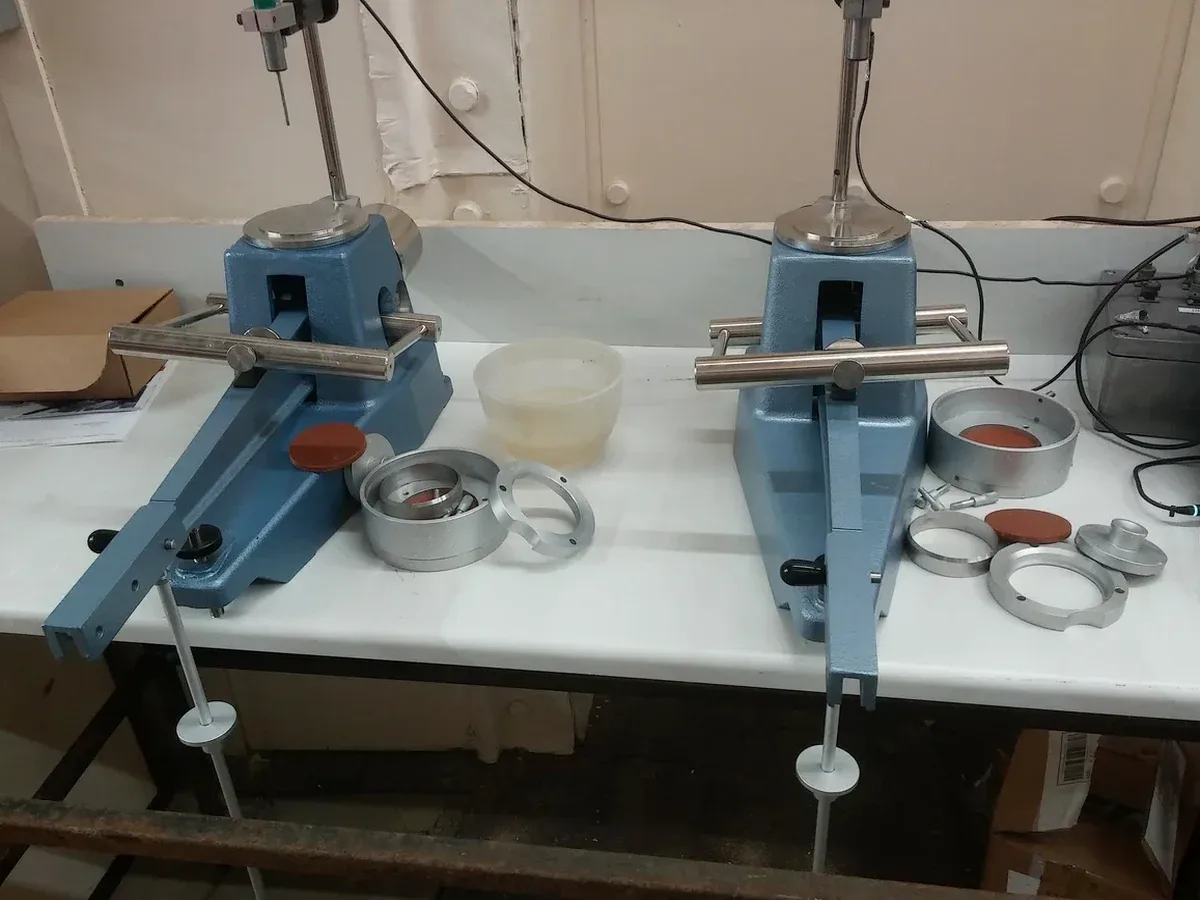
Lethbridge sits at an elevation of 910 meters on the Oldman River valley floor, where the surficial geology shifts within a few hundred meters from alluvial sands to the glaciolacustrine clays of the Lethbridge Northern Irrigation District. Those clays are the reason we run Atterberg limits on nearly every commercial project west of University Drive. When a soil changes from solid to plastic with just a few percent moisture variation, the difference between a stable footing and a seasonally heaving slab comes down to the liquid limit, the plastic limit, and the plasticity index. Our lab processes these tests under ASTM D4318, giving engineers a direct index of the soil's sensitivity to water content.
For deeper stratigraphy where the till transitions to saturated silt, the Atterberg limits provide the classification context needed before running a triaxial shear test to define effective stress parameters for foundation design.
In Lethbridge's semi-arid climate with freeze-thaw cycles reaching 1.5 meters depth, the plasticity index is often the single most predictive number for foundation performance.
Relevant standards
ASTM D4318-17e1: Standard Test Methods for Liquid Limit, Plastic Limit, and Plasticity Index of Soils, ASTM D2487-17: Standard Practice for Classification of Soils for Engineering Purposes (Unified Soil Classification System), CSA A23.3: Design of Concrete Structures (references soil classification for foundation design), NBCC 2020: National Building Code of Canada, Section 4.2 (geotechnical input for bearing capacity and settlement)
Quick answers
What do Atterberg limits testing cost in Lethbridge?
A standard Atterberg limits suite (liquid limit, plastic limit, plasticity index) runs between CA$80 and CA$120 per sample in our Lethbridge lab. The exact number depends on whether we include natural moisture content, hydrometer for clay fraction, or a shrink-swell classification report. Multi-sample projects get discounted rates.
How long does it take to get results back?
Three to four business days is typical for a standard Atterberg limits determination. Samples require oven drying at 110°C before wet preparation, and the liquid limit test alone involves multiple blows per trial. Rush turnaround in 24 hours is available for an additional fee when the contractor is waiting on a fill approval decision.
What soil types in Lethbridge need Atterberg limits testing?
Any fine-grained soil—silts and clays—passing the No. 40 sieve. In Lethbridge that means the glaciolacustrine clays of the Oldman River plain, the Bearpaw Formation weathered shales on the coulee slopes, and the irrigation-affected silts north of the city. Sands and gravels with less than 5% fines generally don't require Atterberg limits, though we still run them if the fines control the soil's behavior when wet.
How do Atterberg limits relate to foundation design?
The plasticity index directly correlates with swell potential and compressibility. A PI above 25 in Lethbridge's climate means the soil will experience significant volume change with seasonal moisture fluctuation. That drives decisions on foundation depth, under-slab moisture barriers, and whether to chemically stabilize the subgrade. The liquidity index tells the engineer whether the soil is currently brittle, plastic, or liquid-like in its natural state, which affects excavation stability and bearing capacity.