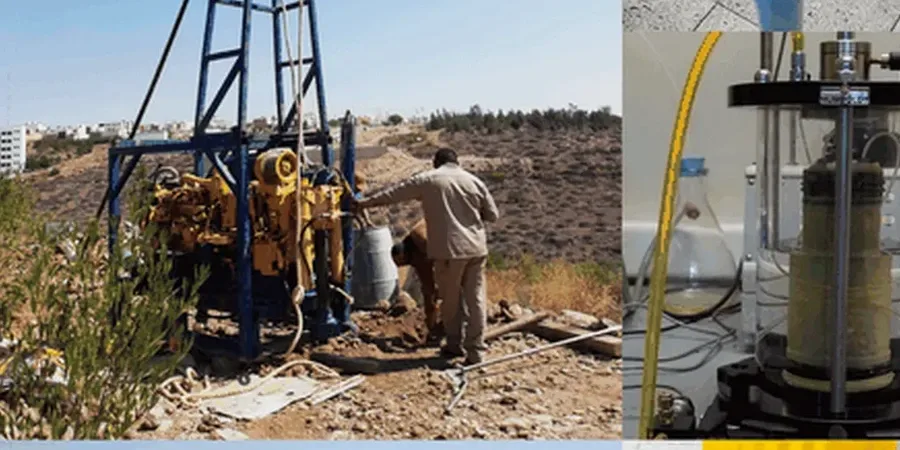
The National Building Code of Canada (NBCC) establishes clear requirements for geotechnical investigations, and in Lethbridge, the interaction between the city's layered glacial deposits and the Oldman River valley creates conditions where a standardized approach rarely suffices. A soil mechanics study goes beyond simple classification to quantify stress-strain behavior, pore pressure response, and shear strength parameters that directly influence foundation design. For projects situated on the clay-rich till that underlies much of the west side or the alluvial sands near the river, understanding these mechanical properties is what separates a cost-efficient design from one burdened with unnecessary conservatism. The engineering team applies triaxial testing protocols to measure effective stress parameters under drained and undrained conditions, while also evaluating consolidation characteristics that predict long-term settlement in the compressible lacustrine clays found in pockets across the city.
The over-consolidated glacial till beneath Lethbridge carries a preconsolidation pressure that often exceeds current overburden by 300 to 500 kPa, a legacy of ice loading that provides a valuable geotechnical advantage when properly measured.
Local ground factors
The geotechnical contrast between Lethbridge's west-side communities like Riverstone, where stiff glacial till provides excellent bearing capacity, and the lower-lying areas near Indian Battle Park, where alluvial and lacustrine deposits are softer and more compressible, illustrates why a single design assumption across the city is risky. On the coulee slopes, the dormant landslide blocks within the Cretaceous shale can reactivate if pore pressures build up during wet years, a condition that standard borehole logging alone will not detect without the mechanical testing to quantify residual strength along pre-existing shear surfaces. The team has observed differential settlement exceeding 30 mm in structures founded on the compressible clays where consolidation testing was omitted, a costly oversight that a targeted soil mechanics study would have prevented through proper prediction of time-dependent deformation.
Quick answers
What is the typical cost range for a soil mechanics study in Lethbridge?
For a comprehensive study that includes triaxial testing, consolidation analysis, and a geotechnical report with foundation recommendations, project budgets in Lethbridge generally range from CA$4,620 to CA$6,290. The scope depends on the number of soil units requiring mechanical characterization and the depth of investigation dictated by the proposed structure.
How does the glacial geology of Lethbridge affect the testing program?
The Saskatchewan Drift till is heterogeneous and over-consolidated, which means that sample disturbance during drilling can significantly reduce measured strength. Our laboratory uses thin-walled Shelby tube sampling and, where feasible, block sampling to preserve the soil structure, and the testing program accounts for sample quality when interpreting triaxial results. The presence of sand lenses within the till also requires that we test multiple specimens to capture the range of drainage conditions.
What is the difference between drained and undrained strength, and which one applies to my project?
Drained strength represents the soil's behavior when pore pressures have fully dissipated under load, which governs long-term conditions for most Lethbridge foundations on till. Undrained strength applies to short-term loading scenarios, such as during construction or for rapid loading of foundations on the compressible lacustrine clays. A proper soil mechanics study evaluates both conditions and specifies which parameter controls each design case.
How long does a complete soil mechanics study take from drilling to final report?
A typical timeline is three to four weeks. The field drilling and sampling phase takes one to two days depending on depth, followed by two to three weeks of laboratory testing because consolidation and triaxial tests require time for saturation, consolidation, and shear phases. The report preparation integrates the test results with the site geology and provides design parameters within one week of completing the laboratory work.
Does the NBCC require a soil mechanics study for residential construction in Lethbridge?
The NBCC mandates that foundations be designed based on a geotechnical investigation that characterizes the soil's engineering properties. For single-family homes on the stiff till of west Lethbridge, a simpler investigation may suffice, but for multi-family, commercial, or any structure on the compressible clays near the river or on coulee slopes, a soil mechanics study with quantitative strength and consolidation parameters is the standard of practice and is routinely requested by the city's permitting office.